September 29, 2011

On my Father's Death


My father passed away on August 28, 2011.
While he was quite sick for the past six years with chronic lung disease brought on by years of smoking, the last month was especially tough on all of us. He persevered and we stood by him. He never complained, so how could we? My mother, his companion of 55 years, knew very well that the endgame was on. But she was the epitome of patience and strength, telling us to also take care of ourselves while caring for him. Many lessons my parents taught me in my formative years were tested in those days.
My early years were spent not knowing my parents. They went for higher studies to USA when I was very young, leaving me in the care of maternal grandparents. It was very late at night sometime in the summer of 1962 that I first saw them - two good-looking strangers who showered much affection and brought me many gifts. The next few weeks went by figuring all this out. The ice was finally broken when on the train to Bombay to collect their shipped luggage the window fell on my hand and took a few nails with it. We were friends after that.
Abbu (as we called him affectionately) taught me the value of hard work and developed my interest in science. He was always surrounded by students, was hardly at home and the best place to meet him was in his laboratory. I was too young in the 1960s to understand that he was setting up a new Biochemistry program at the Aligarh Muslim University (AMU), but figured he must be someone important. I should become like him, I thought.
I enjoyed going to Abbu’s laboratory in one corner of the Chemistry Department, opposite the C-2 lecture theatre in which, many years later, I also attended my first Chemistry class at AMU. My first experiments were done in his lab. For a 6- or 7-year old it was pure magic to see the sudden appearance or disappearance of dark pink color (phenolphthalein) when two colorless liquids (acid and base) were mixed. Years later, when in High School, he encouraged my friends and me to take the National Science Talent examination. Two of us did the project part in his lab. We studied the physicochemical properties of various edible oils to detect adulteration and developed a simple method to estimate the water content of milk. Our research taught us the value of repeat measurements, variation, statistical significance and proper controls.
Abbu nurtured my interest in science and celebrated every success in his own subdued and easy-going manner. I was made to feel good, but not important, and encouraged to do better next time. Importantly, I was allowed to make my own choices. When I gave up the option to study medicine and opted for Chemistry instead, he supported me. By the time I was ready for my Masters degree, Abbu was Head of Biochemistry at AMU. While I liked the subject, the desire to be my own person made me declare that a Masters in Biochemistry from his Department would be my last choice. I never asked him whether my belligerence hurt him and Abbu was too much of a gentleman to raise it. He advised me to go to the Indian Institute of Technology-Kanpur to get my Masters in Chemistry, reasoning that it was the best Chemistry Department in the country, and with a strong background in Chemistry I could easily switch to Biochemistry. I saw the value of that advice many years later.
By letting me take my own decisions and learn from my mistakes, my parents took the fear of the unknown out of me. That confidence has been critical for me as a person and as a professional. Those who play it safe are rarely original. I was allowed early in my life to take risks with the knowledge that my parents trusted me and I would not be alone if I messed up. That is the best gift my parents have given me. I hope I can instill the same confidence in my own children.
Abbu nurtured my other interests as well. There were hunting trips during winter, an activity in which he participated enthusiastically, much to my mother’s dismay. While he himself did not play any sports, he never objected to my three-hour cricket sessions after school or the daily lawn tennis practice in university. He knew I had an academic focus that would not be compromised and trusted my judgment. That confidence allowed me to walk away from AMU in the year I was going to captain the university lawn tennis team, because I had the chance to study at IIT-Kanpur. Those aware of the AMU student culture will find this an uncommon action.
My extracurricular interests also benefitted directly from Abbu’s research activities. My air gun came from Germany and my first aluminum tennis racket from somewhere else he had gone to attend Biochemistry conferences. I became interested in photography very early because I had full access to his Carl Zeiss Contaflex SLR camera, which is still a prized possession. A few cameras and many years later, I am still excited at the prospect of shooting landscapes, people and monuments. There is no better way to spend an entire Sunday in Delhi. My camera also remains my most trusted companion on trips elsewhere.
He was a simple person, had no attitude despite being successful at almost everything he did and remained child-like in his enthusiasm to learn new things. Abbu taught himself computers when these were uncommon and became a vocal advocate for computer-aided learning. Biochemistry was one of the first departments at AMU to give students access to computers. Had he been well the past few years, I am sure Abbu would have been a rage on Facebook.
My parents had superb chemistry. They understood and complemented each other beautifully, and treated each other’s family as their own. My mother cared for my paternal grandmother through her 7-year bed-ridden state following a stroke. She also stood by Abbu as he educated and settled his younger siblings. Abbu on the other hand took care of my maternal grandmother in her later years. He commented on her death that he was now an orphan. The love and care they have provided their other son and my younger brother, who is intellectually challenged, is truly inspirational.
Abbu had been struggling in the ICU in a Delhi hospital since July 26, mostly unconscious and on a ventilator. The pneumonia was severe and had led to septicemia. My mother could not come and relied only on my twice-daily updates. We both knew it was a losing battle. She finally managed to come to Delhi on August 28. We left the hospital at 5:30 pm. Abbu died at 8 pm. The 55-year relationship had hung on for that last meeting.
Farewell Abbu. You were always my hero. Your life will continue to guide and inspire me till I meet my Creator just like you did that evening.


Abbu and Me (Year : 1957)

April 11, 2011

Anna Hazare aur anne hazaron (Anna Hazare and the other thousands) – A Photo Essay


The past week saw dramatic developments in India. Tired of rampant corruption in public life, one man stood up and India responded with vigour.

Anna Hazare, 72, is a social activist and a self-acclaimed Gandhian, who has stood up many times for local issues. The issue at hand now was the Lokpal (Ombudsman) Bill in the Indian Parliament. This legislation has been in abeyance for 42 years with successive governments of all political dispensations avoiding it. The civil society demand was for the Government of India to formulate a drafting committee for the Lokpal Bill with equal representation of Ministers (politicians) and private citizens. The GoI said it was not possible. Anna Hazare said he will fast himself to death until that happens.

Blackmail or force of conviction? Every protest is a form of blackmail. Indians everywhere responded in huge numbers. Thousands thronged to Jantar Mantar in New Delhi, the site of the fast. Thousands also gathered at India Gate, the symbol of our nationhood, every evening for peaceful protests, street theatre, candle light vigils and marches.

The issue was serious but the mood remained festive. People of all ages, religions, urban and rural, rich and poor, came to show support. The crowds were large but orderly. People helped each other, shared views and sang together. They stood by each other because corruption affects everyone.

Was it media managed? Yes, but why should it not be? Why should a powerful medium not be used for a good cause? The voice of the people had to be carried. There were also an estimated 4.4 million tweets in 3 days.

After 4 days the government relented and agreed to the demands. Now begins the hard work of drafting a tough bill that will make sure the corrupt get punished and that it happens with complete transparency and with speed. Only then will India’s real potential be unshackled.

It happened so quickly because the government listened to popular sentiment. A big reason is also the personal integrity of our Prime Minister, Dr. Manmohan Singh. He is probably very deeply affected by the scams faced by his government.

Dr. Singh, rise to the occasion and follow your heart. You have nothing to lose and everything to gain.

Anna, you have shown us the way. Continue to lead but beware of the opportunists in your ranks.

Here are some pictures from my trip to Jantar Mantar and India Gate on Friday, April 8, 2011. Feel the moment.

Jantar Mantar
The crowds descended at Jantar Mantar
It included the young, ....
.... the very young, .....
..... and the old.
They sang, .....
..... helped each other,
.... and made sure their focus was on corruption (not on kulfi-falooda, gulab jamun, etc.
They packed the protest site ......
to listen to this man (not the one with the microphone, but the one in white). Anna Hazare.

They signed banners. I signed the banner. Can you spot my signature?
They hung corrupt politicians, ....
.... but also remembered martyrs in the fight against corruption.
 India Gate
The tricolour was proudly displayed
Handicap was no handicap
Candles were in full display, ...
.... and so were the hands that held them
They also brought other agendas to protest against
In the end, India Gate took everyone in its fold 
Light a candle. Remove the darkness of corruption.

October 21, 2010

Barcelona


This Catalonian metropolis is a colorful mix of extravagant architecture, vibrant street life, and museums and galleries full of artwork from prominent Spanish artists. The soccer team FC Barcelona or simply “Barca” has a cult following, especially after Spain won the World Cup.
Barcelona - An Eagle's Eye View from Tibidabo (Credit: Uzair Siddiqui)
La Rambla
The street life of Barcelona can be seen best on La Rambla – the street that leads down from the busy Plaza Catalunya to the seashore. The boulevard, which has a wide central walking area comes to life in the evening when performers and local artists vie for attention. Over the course of an hour we came across artists dressed as a flowerpot, a large fly and the most ingenious as an ingredient on a large plate of paella (a Spanish rice dish). There was also a fabulous juggler whose silken movements were amazing, and a spray can paint artist who created an ethereal world on paper in under 15 minutes.
The Paella Man
The Spray Can Artist
The atmosphere on La Rambla cannot be described – it can only be experienced. The boulevard is crowded with kiosks selling newspapers, flowers, sweets, ice cream and curios. Amidst all this were young men from Punjab selling scarves sourced from Delhi’s Sarojini Nagar market, and fluorescent helicopters that could be launched from rubber bands – much like the scene at India Gate. La Rambla is one big carnival every evening.

With its 435 pedestrian malls, Barcelona is a walking city where you can stroll its wide parks, where locals come to sit with friends, chat or read a book. Barcelona is also home to Spain’s four biggest names in art – Gaudi, Dali, Picasso and Miro – all eccentric yet brilliant in their own right. While Gaudi’s stamp on this city is omnipresent in the form of his bold architecture of La Sangrada Familia, Park Guell, and various housing projects, Barcelona also houses fantastic galleries featuring the works of Salvador Dali and Pablo Picasso, in whose museum you will see not only his famous cubist pieces, but also some of his early works.

Barcelona hosted the 1992 Olympics and the Parc de Montjuic revives that memory. Besides the Olympic stadium, this area also hosts a museum that features the history and trophies of FC Barcelona – a feat for soccer fans. Tickets come at a premium for Barca games, but a casual tourist can always join victory celebrations at the fountain at La Rambla.

Barcelona is also a good place for shopping – either real or the window type. Almost every city district has fashionable as well as small traditional shops, but these are most prominent along La Rambla and in the Gothic district. For artwork, there is the centre of the Spanish village, Poble Espanyol, on the Montjuic Hill. You can soak in the atmosphere of a busy street that has been around for a thousand years on the European shopping street Sants and Creu Cobarta. There are over 350 shops as also restaurants and bars.
Inside the Gothic Cathedral (Credit: Uzair Siddiqui)
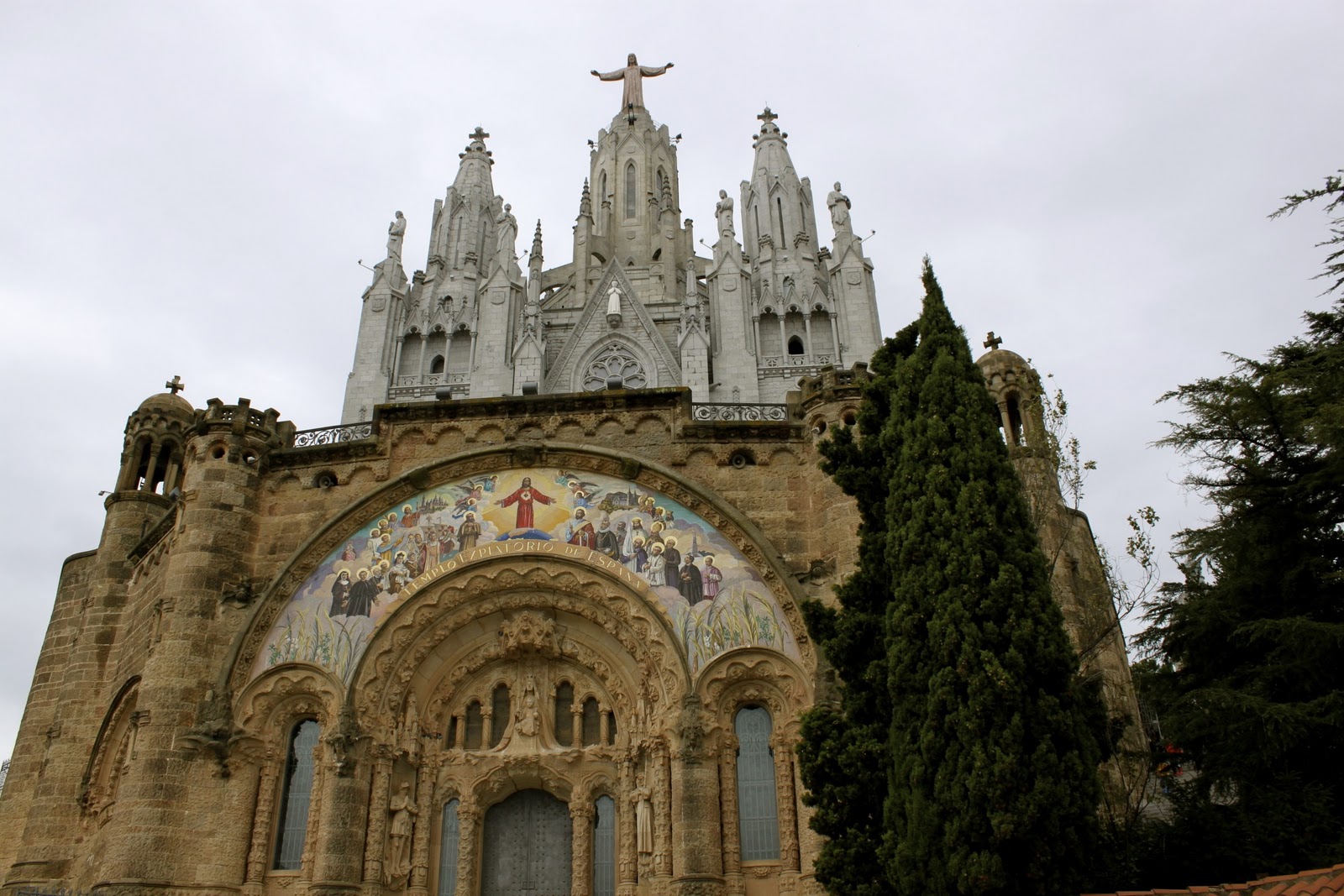
Expiratory Church, Tibidabo (Credit: Uzair Siddiqui)
After a day full of walking and soaking in the sights and sounds of Barcelona, many a tourist can be spotted lazing over a carafe of sangria, a wine punch typical of Portugal, but quite popular in Spain as well. 
Columbus Day Protest (Credit: Uzair Siddiqui)

October 10, 2010

Gaudi Gazing in Barcelona

Barcelona is promoted as a modern European metropolis. Its temperate climate, a killer location on Spain’s Mediterranean coast, but above all, its modern architectural style has made Barcelona an attractive city to visit. In this capital city of the Catalonia province, the Catalan Art Neoveau arose in the presence of an architectural scene of eclectic tastes. Above all else, it is the work of Antonio Gaudi (1852-1926) that stands out in this city.

Antoni Plàcid Guillem Gaudí i Cornet (Antonio Gaudi in its English translation) was a Spanish architect who is famous for his highly unusual and individual style that extended far beyond the scope of Modernisme. We spent the entire day exploring two of Gaudi’s brilliant pieces of work, both designated as UNESCO World Heritage Sites  – Park Guell and The Temple of Sangrada Familia.
Sign at entrance of Park Guell, Barcelona
The businessman Eusebi Guell conceived Park Guell as a garden city, which would bring together the ideal conditions of habitation in the middle of an insalubrious industrial city. He chose Gaudi, who had earlier worked on Guell’s palatial home on La Rambla Street (another Barcelona landmark). Gaudi worked on this park from 1900 to 1914, but the project was later abandoned as a commercial failure. The Barcelona City Council acquired it in 1918 and converted it into a public park in 1923. Park Guell is now one of the best public spaces in Barcelona.
Park Guell, Barcelona
Park Guell was designed as a private urban development in the northern part of Barcelona known as Muntanya Pelada (Bald Mountain). In this rocky terrain full of slopes, Gaudi designed all the necessary services such as viaducts to distribute water, squares and streets, a large entrance stairway to a hall for a covered market. Over the roof of this hall is a large public square bordered by an ergonomically designed winding bench decorated with artwork done using broken tiles.
Public square on top of the columnar hall, Park Guell
Gaudi's tile work, Park Guell
The outstanding feature of Park Guell is its integration of architecture with nature. The Porter’s Pavilion and Keeper’s House Pavilion dominate the entrance, the former with its four-armed cross and both with attractive mushroom-shaped chimneys.
Porter's Pavilion (right) and Keeper's House Pavilion, Park Guell
Gaudi’s most famous project and his labor of love is the Temple of Sagrada Familia. Being a devout Catholic, Gaudi devoted his later years to this project, which he designed to have 18 towers – one each for Jesus, Mary, the 12 apostles and 4 evangelists. Construction began in 1882, slowed down by 1912 due to personal tragedies in Gaudi’s life, the economic hard times in Barcelona and the death in 1918 of his patron, Eusebi Guell. In June 1926 Gaudi was himself hit by a tram and died three days later in a pauper’s hospital in Barcelona. He lies buried in La Sangrada Familia. The work on this project continues up to this day, some according to Gaudi’s original plans, much of which were destroyed in the Spanish Civil War. Work is likely to be completed around 2030, making this perhaps the only World Heritage Site that is still being built.
La Sagrada Familia, Barcelona
La Sangrada Familia is a church of the basilican plan and with a Latin cross, has five naves in the central part and three in the transept. The limit on space has led to its optimum use and explains the cloister around the temple. The style of Sagrada Familia is Gothic, based on controlled geometric structures. It has a paraboloidal base structure, columns in the central nave and a tree-shaped columnar form that supports vaulting of a hyperbolic base and internal modulation of windows that filter and distribute light. Once complete, the church is estimated to accommodate 13,000 worshippers.
Interiors, La Sagrada Familia - The tree shaped columns
Apostle Towers
There are various symbolisms in the structures and the sculptures. Four towers on each of the three facades are dedicated to the twelve apostles, the first bishops of the church. For this reason, Episcopal symbols crown the pinnacles.

The anagram of the Holy Trinity crowns the cypress, the Tau – the first letter of the name of God in Greek, the cross in the form of the cross-piece of the Son (Jesus Christ) and the dove of the Holy Ghost.

Holy Trinity, Tau and the Doves
Gaudi himself completed the eastern façade known as the Nativity Façade. It is ornamented in a baroque fashion with motifs of plants and animals, and of course a nativity scene. Opposite to it is the Passion Façade, on which work started in 1954 and was completed in 1987. The abstract figures, including those depicting the crucifixation, created a storm, as the style was very different from that of Gaudi. The work now focuses on the nave and the southern façade known as the Glory Façade, which will depict life and death.
Nativity Facade
Passion Facade
Entry to the under-construction church is 12 euros; a combined ticket for the church and the Park Guell museum can be purchased for 14 euros. An elevator ride up one of the towers followed by a short climb up the narrow stairs is another 2.5 euros. Beware – the elevator does not bring you down. It’s a long walk down narrow stairs. Those brave enough to go up and then walk down get fantastic views of Barcelona as well as close-up views of the church. It is a photographer’s delight.
Barcelona from Sagrada Familia Tower

October 7, 2010

The Churches of Granada

Granada was the last bastion to fall to Christian armies in 1492 after almost seven centuries of Muslim rule in Al-Andalus. It is therefore not surprising to find grand churches in Granada. It was an expression of newly acquired power. Christopher Columbus also discovered the American continent in 1492 and in time that brought much wealth to the Spanish monarchy. New wealth and new power led to an unprecedented building spree, which is seen nowhere better than in Granada and Sevilla.

The Cathedral de la Anunciacion (also called the Metropolitan Cathedral), dated 1522-1704, is one of the most impressive examples of Spanish Renaissance. Emperor Charles V decided to turn it into a royal mausoleum. In the building five naves are juxtaposed to a rotunda with a double ambulatory, and presents a multiple symbolism. The circular cimborrio (central tower) is also the royal vault, alluding to the Holy Sepulchre in Jerusalem. The central alter indicates a very precise ideology – the sacred sacrament of the Eucharist irradiating over a city that was still Muslim. After the death of its primary architect Diego de Siloe, the main façade was completed by Alonso Cano. It was conceived as a triumphal arch whose tripartite design disguises the interior structure of the five naves and intensifies the play of light and shadow.
Cathedral de la Anunciacion
The Capilla Real (Royal Chapel) was commissioned by the Catholic monarchs Ferdinand and Isabella in 1504 for their burial site; work started in 1506 and finished in 1521. The Chapel is an example of the late Castilian Gothic style: Latin cross plan, with an apse and a choir, ribbed vaults and decorative emphasis in the upper part of the wall. On the inside, the most outstanding features are the Renaissance grate located in the transept, the sepulchers of the monarchs and those of Felipe the Handsome and Queen Juana, and the alterpiece of the Holy Cross. On the outside, the Chapel has only one façade, with a front dated to 1526 and rebuilt in 1733 to unite it to the Cathedral complex. At the bottom of the nave, another front leads into the Iglesia del Sagario.
Capilla Real, Granada
The Iglesia de Sacrario, dated 1705-1722, is in the Baroque style and occupies the site where the Major Mosque of Granada used to stand. The building follows on a smaller scale the Basilica of Saint Peter – Greek cross inside a square. A hemispherical dome covers the central part and domical vaults cover the four sides of the transept. The front is divided into two parts, with sculptures by Augustine Vera Moreno in the second part – Saint Peter in the middle, flanked by Saint John Nepomuceno and Saint Ivo.
Iglesia de Sacario, Granada
In the immediate vicinity of the Cathedral are two educational institutions – Antigue Universidad Literaria and La Madrazza. The University building is dated 1527-1544 and is in the Renaissance style. Emperor Charles founded it in 1526 to indoctrinate the Muslims who remained under Christian power after the conquest of Al-Andalus. After the expulsion of the Jesuits in 1767, the teaching was transferred to the old Colegio de San Pablo de la Compania de Jeus and the building became a heritage site. La Madrazza (The Madrasa) was established in 1349 by Sultan Yusuf I as a school and university. It is stated to have a splendid prayer hall and mihrab, but sadly it was closed for repairs.

Puerta del Pardon is a cathedral in the Renaissance style dating to 1537, with the second part done in 1810. Its name comes from a convicted criminal who sought refuge in the cathedral and was later pardoned. Roman triupmphal arches provided inspiration for its design, signifying the victory of Christian forces. Above the spandrels of the lower arch are the allegorical figures of Faith and Justice, which suggest that the land was given to Christian monarchs because they acted with faith and justice.
Puerta del Pardon, Granada

Puerta del Pardon, Granada
The Hospital Real (Royal Hospital) is as grand as any early to mid-16th century church in Granada. It is built on a Greek cross plan with each quadrant consisting of a fountain courtyard and rooms in the surrounding verandah. The transept is crowned by a central tower. The construction of this hospital is dated 1511-1599; the frontispiece dated 1632 is one of the finest in Granada. Hospital Real was built on the orders of King Fernando V, as part of a public service programme undertaken by the Crown following the conquest of Granada. This building is now part of the University of Granada and houses a large library. Strangely, this was the only building in Granada in which we had to pass through metal detectors and our bags were also screened through X-ray.
Frontispiece, Hospital Real
Fountain Courtyard, Hospital Real

Fixing the Leaky Pipeline for Leelavati’s Daughters

Women (and men) with a passion for science management. The authors Bela Desai (front row 2nd from left) and Shahid Jameel (back row extre...